When you climb out of the water, your hands and your whole weight go onto the edge of the pool. That piece is the coping, and it shapes how the outline of the pool looks, where you sit with your feet in the water and how the edge copes with years of sun, chlorine and frost.
Here is how to choose the edge, the finish and the stone, the last one with the flexural tests of our eight sandstones. If you are still choosing the stone for the whole pool, start with our guide to natural stone pools.
In this guide: What coping is · Edges and special pieces · Flexural strength · Slip-resistant finish · Coping and deck · FAQ
What pool coping is
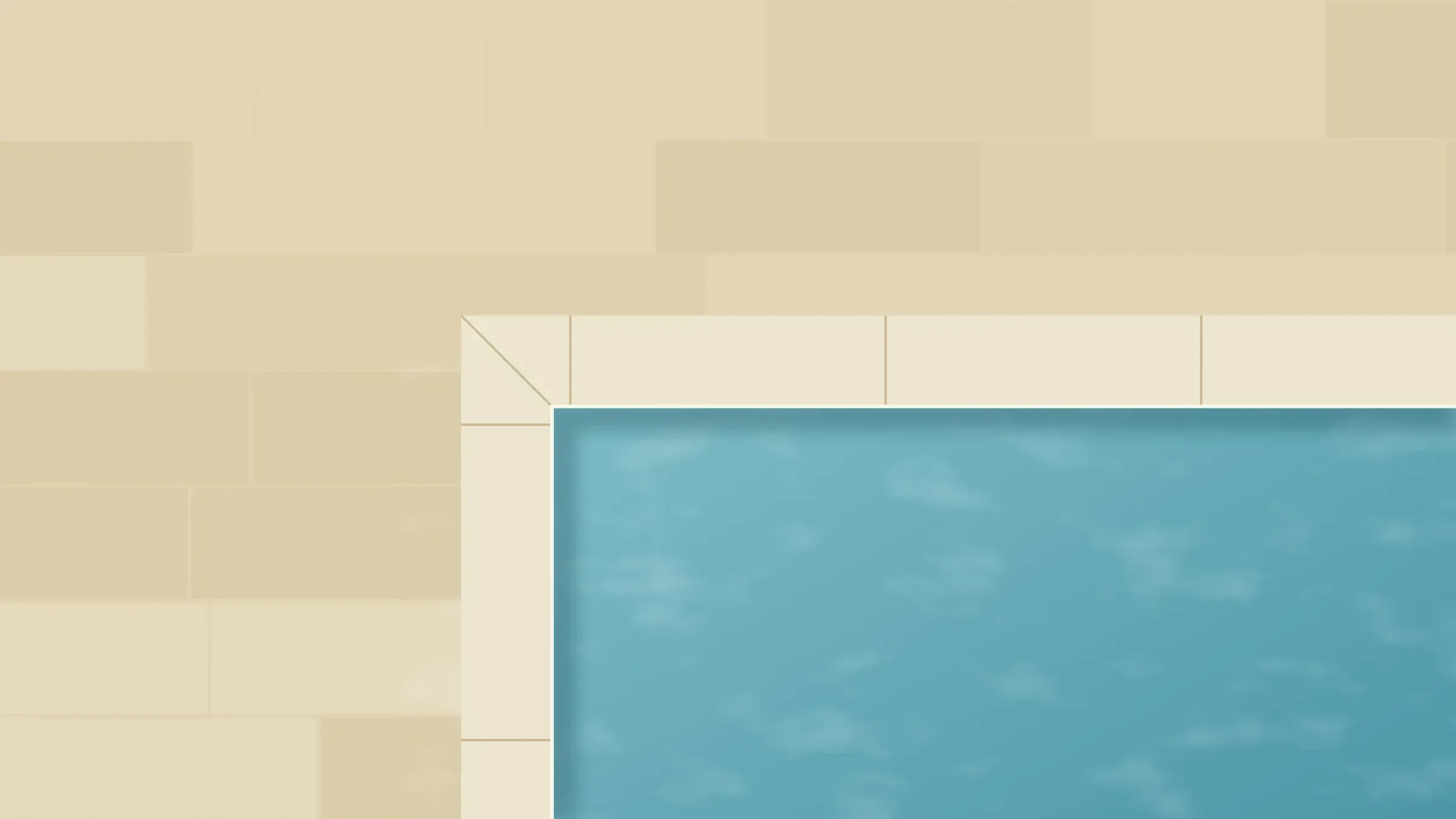
Coping is the course of stone that caps the edge of the pool shell and separates it from the deck, the paving around the pool. In Spanish it is also called albardilla, the general word for any stone that caps the top of a wall.
It takes your weight as you get in, get out or sit on the edge, and it covers the top of the pool wall to stop water seeping in behind the lining. It is also the only piece that runs right round the pool, so it sets the line you see from anywhere in the garden.
That is why it is designed at the project stage, with its own cutting list, and not as one more row of paving.
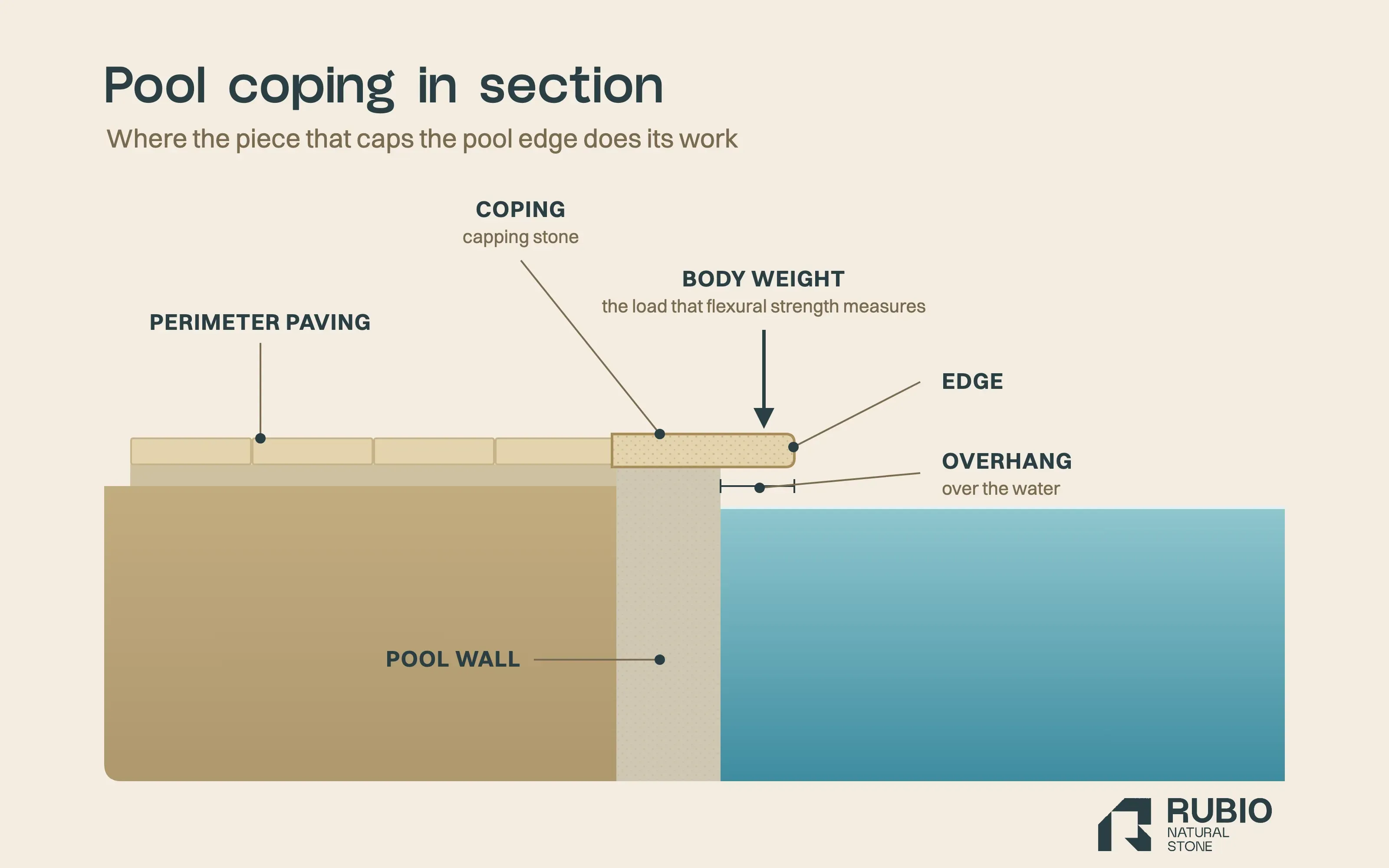
The coping bears on the pool wall and overhangs the water. That overhang is where flexural strength comes in.
Coping edges and special pieces
The edge is the face of the piece that looks onto the water. A square edge keeps the line crisp and lets the pool read as a clean volume, which suits contemporary architecture. A rounded edge is kinder to your arms and legs when you lean or sit, and fits family pools and more traditional settings.
Then there are the pieces that are not straight:
- Corners, inside and outside, made as a single piece rather than two mitred cuts on site.
- Curved runs for free-form pools or curved steps, cut to the radius on the drawing.
- Entry steps in the same stone, so the stair carries on from the coping.
- Skimmer junctions, with the opening machined to size.
All of them are cut and machined at our factory in Les Borges Blanques from the pool drawing. We work slabs up to 3 m long and from 2 to 50 cm thick, so a long run of coping can be laid with few joints.
Flexural strength of coping stone
A coping stone sits on the pool wall and often overhangs the water. That is why its key technical figure is flexural strength: the load that breaks a piece supported at both ends when it is pushed in the middle, given in megapascals (MPa). The higher it is, the more load the piece takes at the same thickness, or the thinner it can be for the same load.
The pool edge also gets wet and, in many climates, freezes. The frost resistance test puts the stone through freeze-thaw cycles and measures its strength again at the end, so the second column shows how much strength each sandstone keeps after those cycles.
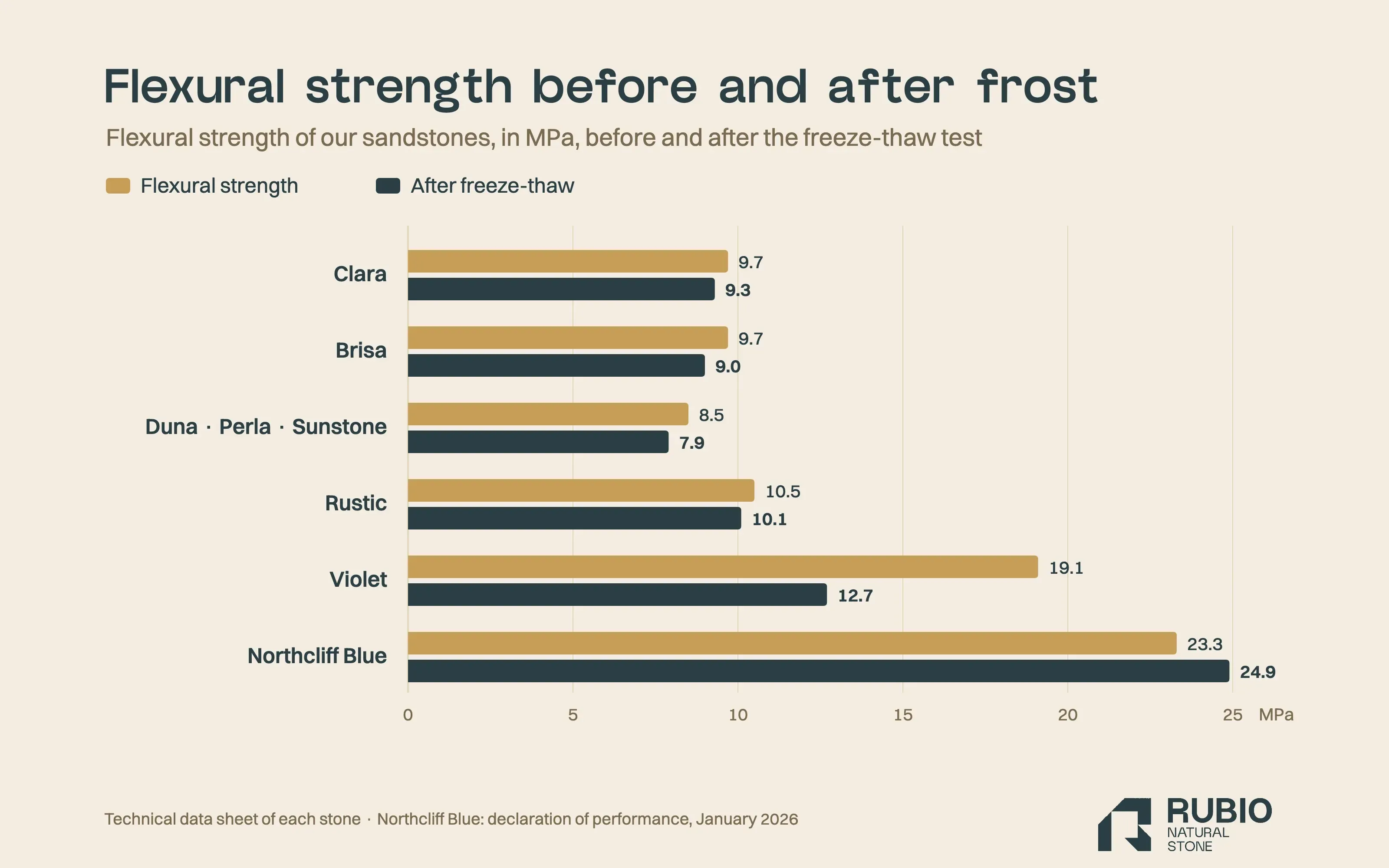
| Sandstone | Flexural strength (MPa) | Strength after freeze-thaw (MPa) |
|---|---|---|
| Clara | 9.7 | 9.3 |
| Brisa | 9.7 | 9.0 |
| Duna, Perla and Sunstone | 8.5 | 7.9 |
| Rustic | 10.5 | 10.1 |
| Violet | 19.1 | 12.7 |
| Northcliff Blue | 23.3 | 24.9 |
Technical data sheet of each stone; Northcliff Blue, declaration of performance of January 2026.
The calcarenites (sandstones bound by a lime cement) keep almost all their strength after frost, losing less than one point. Northcliff Blue is the only one that comes out of the test stronger than it went in. Violet starts at 19.1 and ends at 12.7, still more than any calcarenite before the test.
In practice, for a residential pool in a mild climate we recommend a calcarenite with the thickness matched to the overhang. For large overhangs, very long pieces or winters with regular frost, we recommend Northcliff Blue or Violet, which give the same edge with more margin.
Slip-resistant finishes for the pool edge
The edge is walked on barefoot and wet. Building codes ask for high wet slip resistance around pools; how it is measured and what our sandstones score is in our guide to natural stone for swimming pools.
For coping we recommend three finishes:
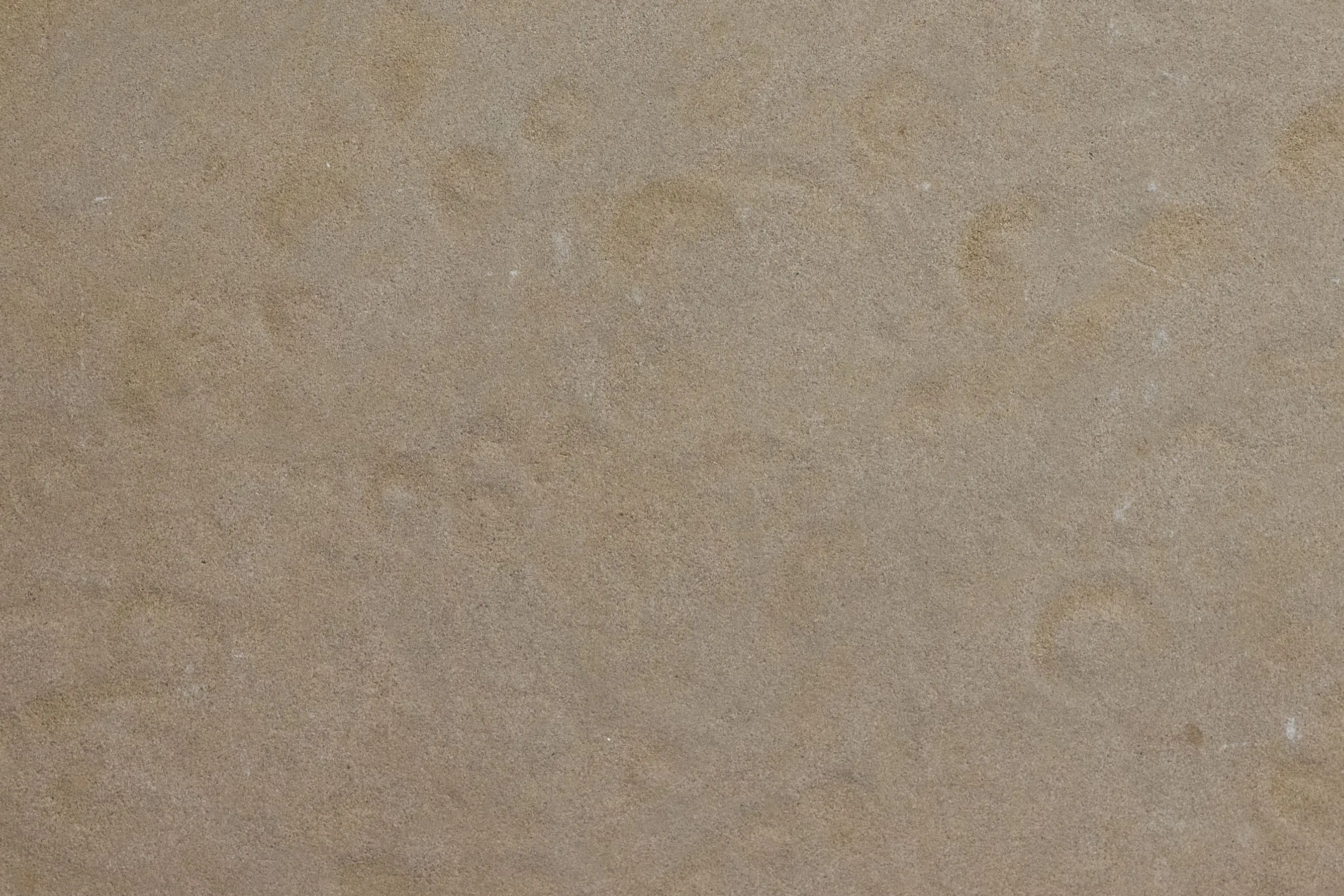
- Medium or coarse bush-hammered, the stippled texture we recommend outdoors and in wet areas.
- Sandblasted, a fine relief that gives grip with a more understated surface.
- Flamed, only on Violet and Northcliff Blue, whose hardness allows the thermal shock used to create it.
Polished finishes stay off the edge. To see each texture in more detail, read our article on natural stone finishes.
The same stone for coping and deck
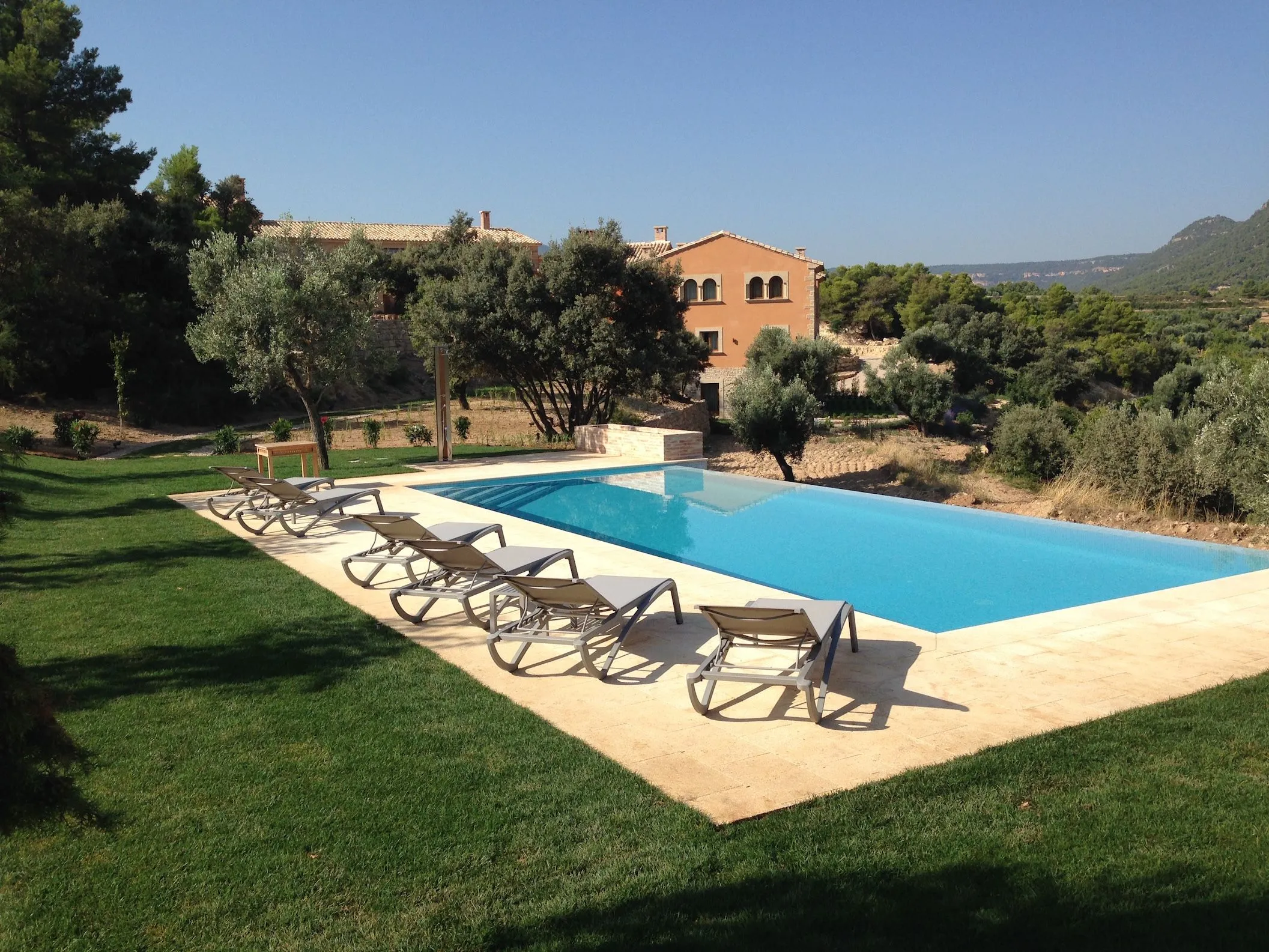
When the coping and the deck are in the same stone, the edge no longer looks like a trim added at the end. At the Mas de la Costa hotel, a farmhouse from 1804 restored in Valderrobres (Teruel, Spain), Duna sandstone is used for the arches, the outdoor paving and the pool area, with the pool edge in the same toasted stone as the rest of the building.
Our catalogue also shows pool coping laid in Perla.
If you would rather use another stone for the edge, the Rubio Selection line adds limestones, travertines and marbles to our sandstones.
Frequently asked questions
What is the difference between pool coping and a wall coping?
They are the same kind of piece. On a garden wall, coping only sheds rain; on a pool it also takes people sitting and leaning on it, so edge profile and grip matter more.
Which natural stone is best for a pool edge?
It depends on the climate and the use. Where winters are mild and the pool is for a family, any of the calcarenites, such as Duna, Perla, Clara or Brisa. Where frost is regular, overhangs are large or the pool serves a hotel, Northcliff Blue or Violet, for their flexural strength.
Can the coping follow a curved pool?
Yes. Curved pieces are cut at the factory to the radius on the drawing, like the corners and the skimmer junctions, and arrive on site ready to lay.
Is natural stone coping suitable for a saltwater pool?
Yes, salt chlorination is compatible with natural stone. On the more porous varieties it is best to avoid standing water on the edge; our pool guide explains how to prevent salt efflorescence.
If you are designing a pool, send us the drawing of the pool shell with its dimensions and the climate of the site. We will propose stone, edge and finish for the coping and send you samples to try wet.