Some stone samples look perfect in the showroom and fail at the water’s edge. The reason is simple. Around a pool, stone is walked on barefoot, wet, and under the full summer sun.
Choosing the right natural stone for a swimming pool comes down to four decisions: where it will work, how it behaves wet, what water, climate and use it will face, and which finish and pieces go with it.
This guide runs through them in that order, backed by the test data from our own sandstones.
In this guide: where the stone works · does it get slippery? · water, climate and use · which sandstone · the finish · coping · the pool interior · porcelain? · a built case · FAQ
Where the stone works in a pool
A pool has three zones, and the stone works differently in each:
| Zone | What it asks of the stone | Typical pieces |
|---|---|---|
| Pool deck (surround paving) | Grip barefoot and wet, comfort to the touch, moderate temperature in the sun, resistance to traffic and cleaning | Paving slabs, steps, edges meeting garden or lawn |
| Coping (pool edge) | Safe body support, run-off control, protecting the edge from water ingress | Straight and curved coping, corners, skimmer and overflow pieces |
| Pool interior (the shell) | Permanent immersion, very low absorption, stability against treated water | Interior cladding in slab or smaller formats, with a selection specific to immersion |
All three can be done in natural stone, each with its own piece, finish and level of demand. So when you ask for a quote, always break it down by zone.
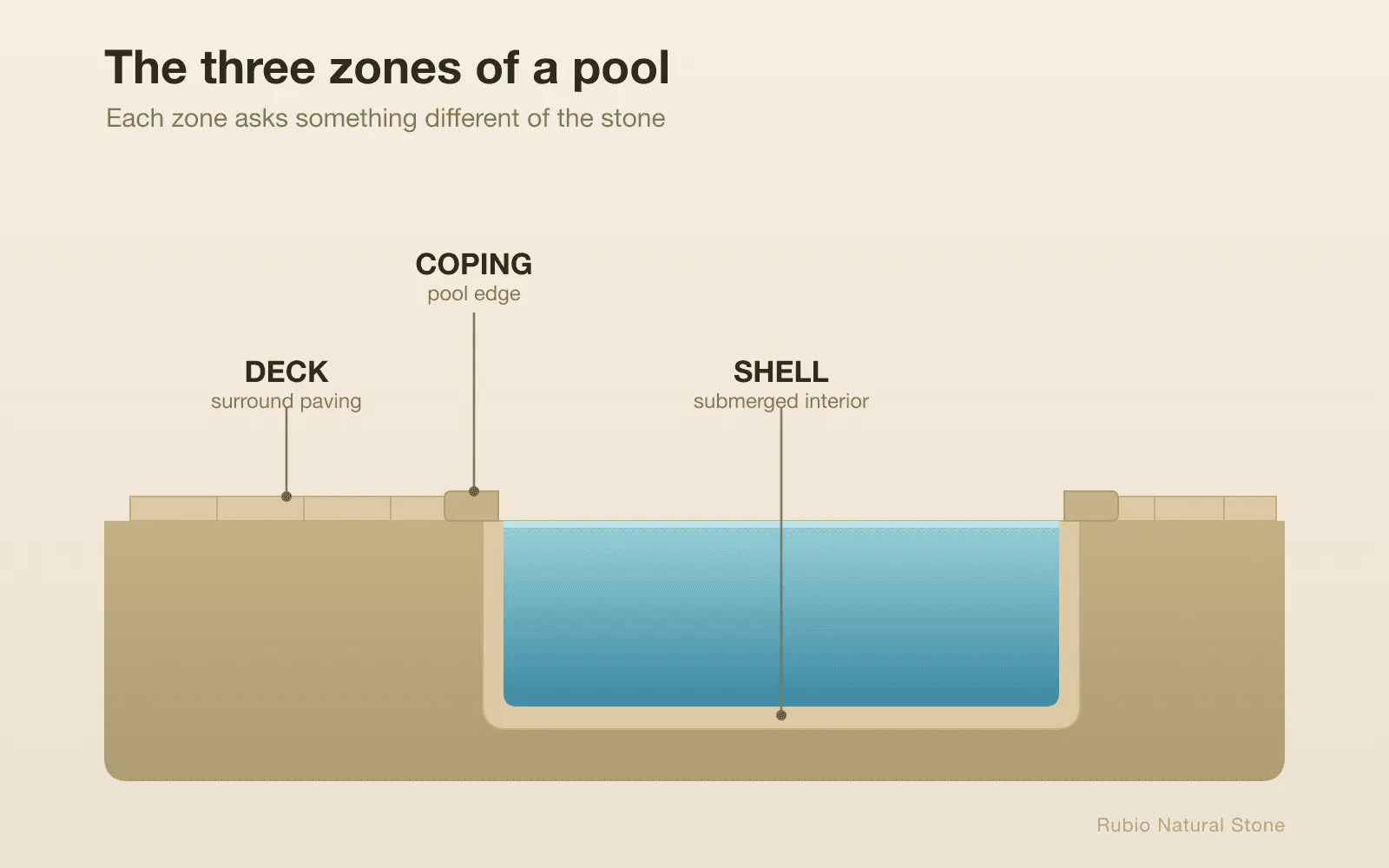
The three zones of a pool: deck, coping and shell. Each one defines piece, finish and level of demand.
Does it get slippery? The question that allows no compromise
Everything else about a pool can be negotiated: the tone, the format, the layout. This can’t. Around water, wet grip comes before anything else.
And it has a test and a number, whatever your country’s code. The international references are the pendulum test, which gives a Pendulum Test Value (PTV), and the German ramp standards: DIN 51097 rates wet barefoot areas (Class A/B/C, where pool surrounds call for Class B, and Class C for steps and ramps into the water), while DIN 51130 gives the R-values (R9–R13) used for shod areas. In Spain, for example, the building code (CTE DB-SUA) requires the top class, Rd above 45. The label changes from country to country; the principle doesn’t.
In the tests on their technical data sheets, the calcarenites (sandstones whose grains are cemented with lime) Clara, Brisa, Duna, Perla and Sunstone give wet pendulum values of 78 to 83, Rustic reaches 85 and Northcliff Blue gives 65. All sit above the PTV of 36 that marks low slip potential, and in the calcarenites that grip is built in. The microtexture of cemented sand grains already works as an anti-slip, and the right finish sharpens it.
Before you sign off on a stone:
- Wet the sample. Step on it, compare it with others under the same light. Some surfaces look rough dry and turn treacherous wet.
- Grade the demand by zone. On coping and steps, the most control; the deck by the water, safety with a comfortable touch; the areas further from the pool can ease off a notch without the whole losing unity.
Water, climate and use: three facts before choosing the stone
What water will the pool run on? Chlorine and salt chlorination both sit well with natural stone. With salt, the attention goes to the more porous varieties: a sealer, drainage with no standing water and the odd fresh-water rinse keep efflorescence at bay. The one case that calls for a prior check is a biofiltration pool, where the stone has to respect the water’s biological balance.
What climate is the site in? What damages stone in winter is the water that freezes inside it. Where there are frosts, the key figure is absorption: the classic calcarenites sit around 12%, Rustic drops to 9.9% and Northcliff Blue to 0.8%. The harder the winter, the further down that scale you choose.
What use will it take? A family pool and a hotel pool live different lives. The second racks up hundreds of swims a day, industrial cleaning and furniture on the move. The more use, the more mechanical strength, abrasion resistance and thickness you ask of the piece.
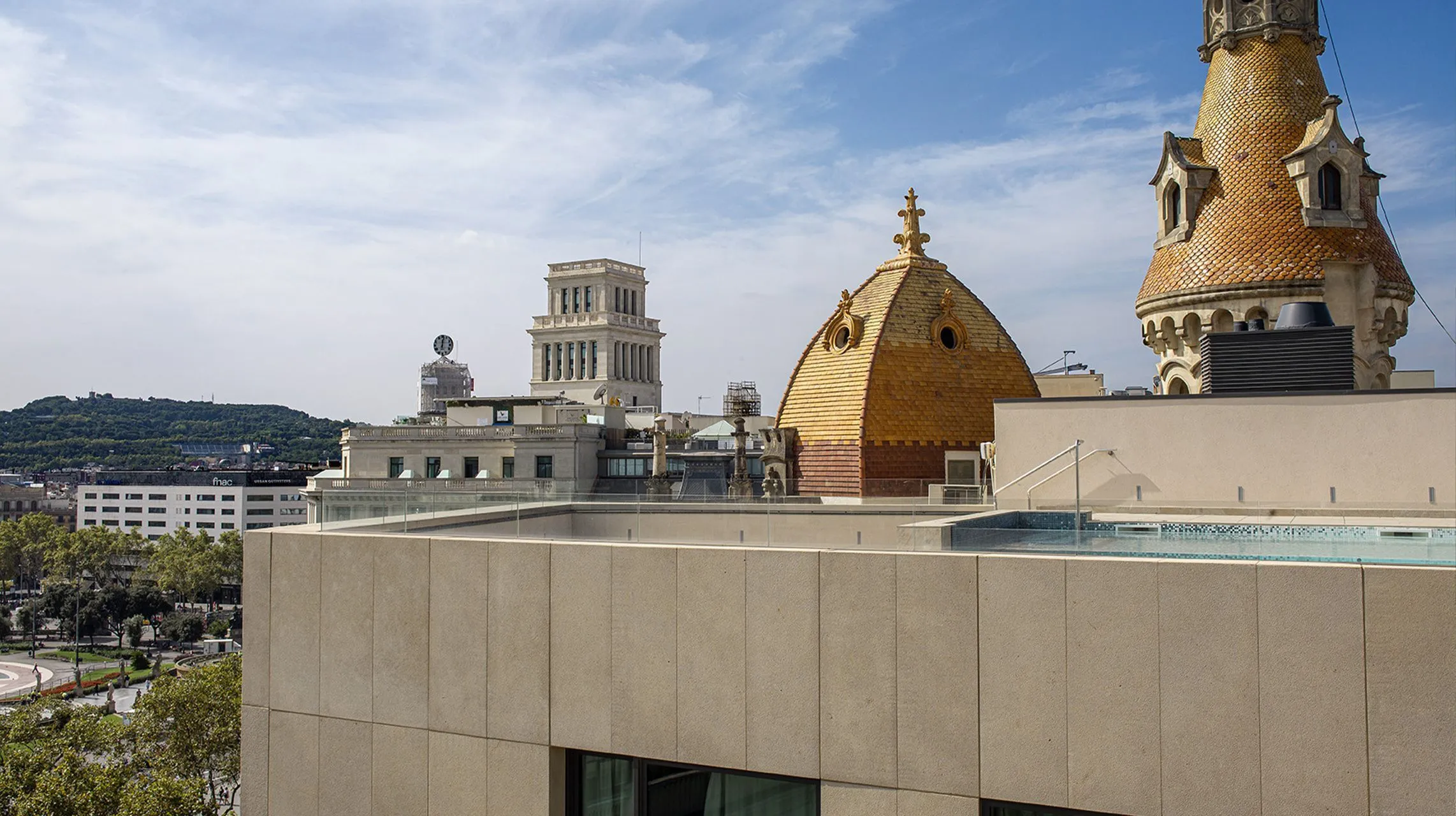
ME Barcelona hotel: the rooftop pool over the city skyline, with the envelope in bush-hammered Perla sandstone.
Which sandstone to choose for a pool
Our eight sandstones fall into two groups. The calcarenites are Clara, Brisa, Duna, Perla, Sunstone and Rustic, all warm-toned. Violet, a quartz arenite (its grains are almost all quartz), and Northcliff Blue, a lithic arenite (with fragments of other rocks among its grains), are the strongest. With that screening done, each scenario points to two or three varieties:
| If your project is… | Our suggestion | Why |
|---|---|---|
| A Mediterranean residential pool | Duna, Perla, Clara or Brisa | Beige, cream and tan tones that soften the light, gentle underfoot, wet pendulum values of 78–83 |
| An inland climate with frosts | Rustic or Northcliff Blue | Absorption of 9.9% and 0.8%: less water inside the stone when the freeze arrives |
| A hotel, spa or heavy-use pool | Rustic, Violet or Northcliff Blue | 86–211 MPa in compression and better abrasion under continuous traffic |
| A restoration or heritage feel | Sunstone or Duna | Visual continuity with the existing fabric and hand-worked masonry finishes |
| In travertine, limestone or marble | The Rubio Selection line | International marbles, travertines and limestones that widen the palette beyond sandstone |
The first row is the most common and the most rewarding: a Mediterranean pool is the calcarenite’s natural habitat. Clara and Brisa are the most luminous and neutral; Duna and Perla, the warmest. Duna, Perla and Sunstone share identical test values, so among them the choice is purely aesthetic and can be made with the sample in hand.
Violet and Northcliff Blue are the answer for hard inland frosts, relentless hotel use or when you want the highest strength in the range. Without those conditions, a well-finished calcarenite is the more balanced choice, and the one that best understands the Mediterranean landscape.
And if no row quite fits, tell us about the project. We work natural stone end to end, from quarry to finished piece, and we’ll propose the solution that resolves it best, whether sandstone, travertine, limestone or marble.
The finish is the anti-slip
Two slabs of the same stone can behave like different floors. It all depends on the finish of the visible face. From most to least grip, these are the ones we specify around water (the full range is on our finishes page):
- Flamed. Roughness from thermal shock, only possible on Violet and Northcliff Blue because of their hardness. The finish for heavy-use or harsh-climate pools resolved in these stones.
- Bush-hammered. Even, stippled texture, in fine, medium and coarse variants. The all-rounder for decks, coping and steps, with frank grip and a stony look.
- Sandblasted. Fine, organic relief from a sand jet. Perceptible grip with the most understated surface, the most contemporary option.
- Brushed. A soft touch that brings out the vein, much asked for on Mediterranean-style decks; on steps and coping, a grippier texture works better.
- Antik. A soft texture with a rustic Mediterranean feel, for decks that want patina and memory.

Bush-hammered: an even stippled texture. The all-rounder for decks, coping and steps.

Sandblasted: fine, organic relief with a contemporary look.
And the smooth finishes? Honed has its place in the covered or dry areas of the surround; as the main deck surface, treat it with caution. Polished and gloss finishes are out: wet, they lose the grip they seem to have when dry.
The finish is chosen by crossing stone, zone, climate and planned maintenance. Habit is not a criterion.
Coping: profiles and special pieces
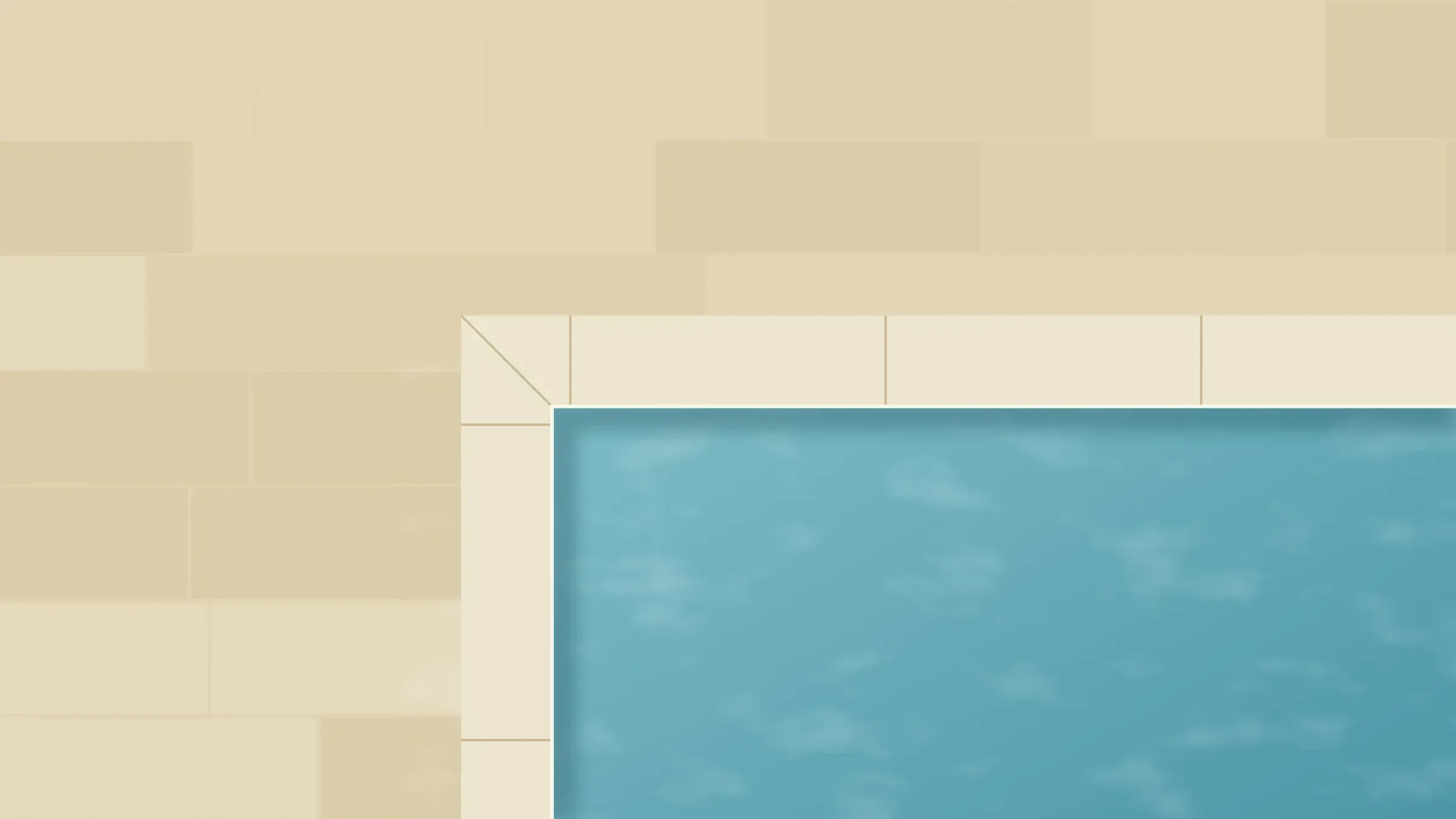
Coping is the most-used piece in the whole pool. You lean on it getting in and out, you sit on it and it draws the outline of the pool. That is why it is defined at the design stage, with the edge profile, the special pieces (corners, curves, steps, skimmer) machined in the workshop to the real layout, and continuity with the deck in the same stone. Our catalogue documents pool coping resolved in Perla.
The flexural strength of each sandstone, before and after frost, and the detail on edges and pieces are in our article on natural stone pool coping.
Lining the pool in stone: the colour of the water
The colour of the water comes from whatever lines the pool. What changes with stone is the nuance. A mineral bed tints the water a living, deep colour, with more body than a flat, uniform lining. Light tones give luminous sheets, sand and turquoise; grey or blue stones turn it deeper, almost like a natural pool. That’s why stone-lined pools seem to belong to the ground rather than sit on top of it.
Underwater, what rules is low absorption (the profile of Northcliff Blue, at 0.8%) and good compatibility with the water system, checked at the project stage. Smaller formats help on curves, steps and junctions.
When shell, coping and deck are resolved as a single piece, the whole pool gains coherence.
Want your pool in natural stone? Tell us about your project and we’ll help you choose the stone.
And wouldn’t porcelain be more practical?
Porcelain that looks like stone offers industrial uniformity and large formats, and in that very uniformity lies its limit: repeating prints, a colder touch and a relationship with outdoor light that never reaches the depth of the real material. Precast concrete starts cheaper but ages worse; it degrades season after season, while sandstone gains patina.
And a figure that weighs more every year: according to the sector EPDs from the Natural Stone Institute we cite on our sustainability page, a natural-stone paving carries 22.0 kg CO₂ eq/m² against 73.2 for terrazzo: 70% less. Producing stone means quarrying and cutting, with no kilns and no resins, and at the end of its life the pieces are recovered and reused.
Natural stone takes more judgement to choose. In return it gives a surface that belongs to the place and improves with the years.
A pool with years of sun on it: Mas de la Costa
In Valderrobres (Teruel, Spain), the 1804 farmhouse restored as the hotel Mas de la Costa resolved its arches, structural elements, outdoor paving and pool area in our Duna sandstone. The same tan calcarenite, with its orange nuances, runs through the building and reaches the water. That continuity makes the pool feel older than the hotel itself, as if the farmhouse had been built around it.
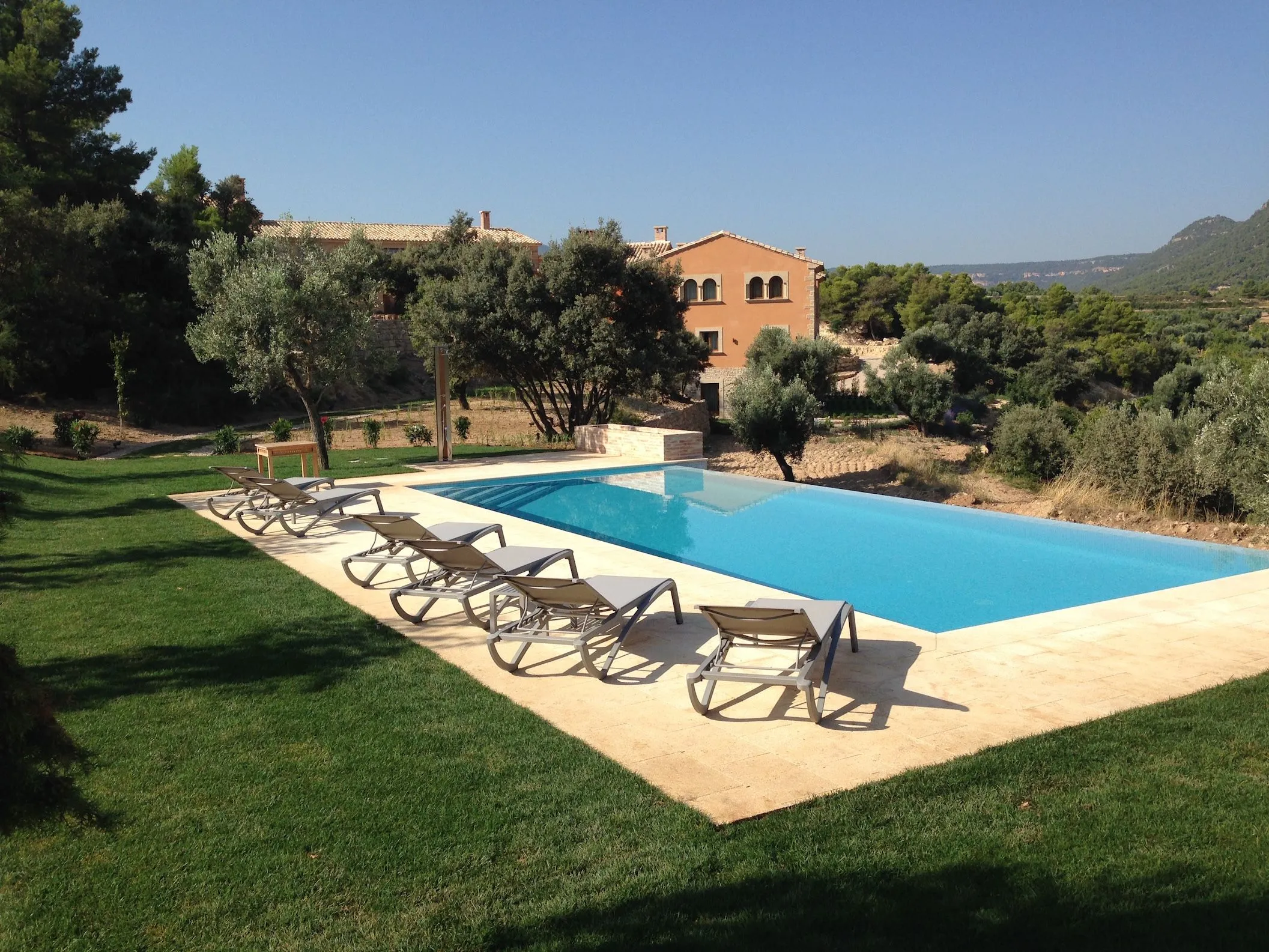
Mas de la Costa (Valderrobres, Teruel): the pool and its surroundings, resolved in Duna sandstone.
Since 2020 it has been racking up seasons of sun, water and hotel use. It’s the kind of proof no data sheet offers, and it can be seen alongside other cases on our projects page.
Frequently asked questions
Which is the best natural stone for a swimming pool?
There’s no universal stone; there is one right for each project. In a Mediterranean climate and residential use, the calcarenites (Clara, Brisa, Duna, Perla) offer the best balance of warm looks, comfort and safety; in cold climates, very heavy use or the most demanding technical briefs, Rustic, Violet and Northcliff Blue bring lower absorption or higher strength.
Is natural stone slip-resistant when wet?
It depends on the stone and, above all, on the finish. According to their technical data sheets, our calcarenites give wet pendulum values of 78 to 85 and Northcliff Blue 65, above the PTV 36 that marks low slip potential. Textured finishes (bush-hammered, sandblasted and, on Violet and Northcliff Blue, flamed) add grip. A polished finish, by contrast, turns any stone into a hazard by the water.
What do slip-resistance standards require around a pool?
Wherever you build, pool surrounds call for a high wet slip-resistance rating: DIN 51097 Class B for barefoot areas (Class C for steps and ramps into the water), or R11 and above under DIN 51130, or a pendulum value comfortably above the low-slip threshold. In Spain the building code (CTE DB-SUA) requires the top class, Rd above 45.
Does stone get hot in the sun? Can you walk on it barefoot?
Light tones and the porous structure of sandstone give a noticeably cooler surface than dense, dark materials. It’s one reason beige, cream and tan tones dominate Mediterranean pool decks. Either way, judge the sample outdoors in full sun, just as you judge it wet.
How does chlorine or salt chlorination affect sandstone?
Both systems are compatible with natural stone. In porous varieties, a sealer and coping with no standing water hold off salt efflorescence. A prior check is reserved for biofiltration pools, where the water works as an ecosystem and the stone has to respect it.
What is pool coping?
It’s the piece that finishes the pool edge: it takes the body’s weight getting in and out, governs the fall of the water and protects the edge from water ingress. It comes with a square or rounded edge and with special pieces (corners, curves, skimmer) machined to the real layout. Our guide to natural stone pool coping goes into detail.
Can a pool be lined with natural stone?
Yes. Submerged stone sets the colour of the water and lends it a vividness that mosaic or a liner can’t. It calls for a stricter selection than the deck (very low absorption and verified compatibility with the water system), so it’s studied project by project with the technical team.
What maintenance does pool stone need?
Regular gentle cleaning with products suitable for natural stone, removing leaves and debris before they set, an annual check of joints and special pieces, and a sealer only where appropriate. No acids, no shock cleaning.
What determines the price of natural stone for a pool?
The variety and its quarry availability, the format and thickness, the finish, the special pieces (coping, corners, steps, curves) and the volume of work. Working with our own quarries and workshop, we can adjust layout and format to the project’s real budget: the most reliable route is a consultation with measurements and plans.
If you’re choosing natural stone for a pool, tell us the site’s climate, the water system and the intended use, and ask for samples to wet-test. We’ll come back with stone, finish, layout and coping pieces, with the test data on the table: the four decisions of this guide, applied to your project.